AI Jobs in Canada 2026: The Skills Employers Pay For
AI-skill job postings in Canada more than doubled in 2025, from 1.6% to 3.5% of all postings. Here are the roles hiring, the skills that get you hired and a 90-day plan to switch into AI.
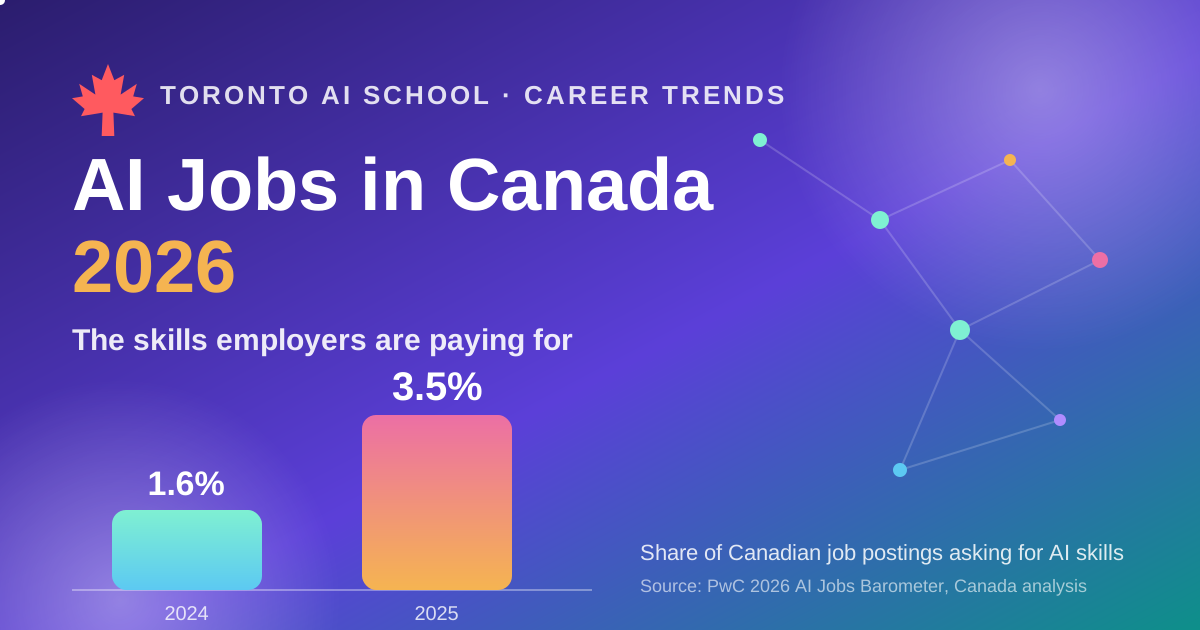
Short answer: AI jobs in Canada are growing fast, and the people getting hired are not only researchers. Employers want professionals who can build AI agents, connect them safely to business systems, and prove they work. In 2025 the share of Canadian job postings asking for AI skills more than doubled, from 1.6% to 3.5% (PwC). Here is what that means for your career, and the exact skills to learn next.
What is happening in the Canadian AI job market
PwC’s 2026 AI Jobs Barometer analysed hundreds of millions of job postings. For Canada, it found that job postings requiring AI skills grew by about 69,000 in 2025, and their share of all postings more than doubled in a single year (PwC Canada analysis).
Globally, the same research reports that jobs asking for AI skills are growing 69% compared with 9% for the job market overall, and that roles requiring AI skills carry a wage premium of 62%, up from 57% the year before (PwC global findings). Canada’s technology council, ICTC, projects the country’s AI industry to grow by about 33.9% a year between 2023 and 2028 (ICTC).
The twist: junior roles now need “senior” skills
The most surprising finding is about entry-level work. PwC reports that AI-exposed junior roles are about seven times more likely than other junior roles to ask for skills we used to expect from senior staff, such as leadership and strategic thinking (PwC). The skills inside AI-exposed jobs are also changing about twice as fast as in other roles.
In plain terms: AI handles more of the routine work, so even a first job expects you to make judgement calls. Knowing a tool is not enough. You need to know when to trust it, how to check it and how to explain the trade-offs to a manager.
Five AI roles Canadian employers are hiring for
- AI / agentic AI engineer: builds assistants and agents that use tools, retrieve company knowledge and complete multi-step tasks.
- Enterprise AI architect: designs the whole system: models, data, security, cost and how everything is evaluated before launch.
- AI governance, risk and assurance specialist: turns policies and regulations into controls, tests and evidence that boards and auditors accept.
- MLOps / AI platform engineer: runs AI in production with monitoring, cost control and safe releases.
- AI product and transformation lead: finds where AI creates value and leads teams through adoption.
The skills that get you hired in 2026
- Agentic AI design: tool use, multi-agent patterns and, most importantly, the limits you put on what an agent may do on its own.
- Retrieval-augmented generation (RAG): answers grounded in company documents, with permission filters and citations.
- Evaluation: golden test sets, groundedness and safety checks that run before every release.
- AI security and governance: prompt-injection defence, privacy, audit trails and frameworks such as the NIST AI RMF and ISO/IEC 42001.
- Cloud and cost awareness: deploying on platforms like AWS, measuring cost per task and keeping latency low.
- Communication: explaining a technical decision to a non-technical sponsor in two minutes. This is the “senior skill” junior roles now ask for.
A 90-day plan to move into AI
- Days 1–30: learn how large language models, RAG and agents work, and build one small assistant over your own documents.
- Days 31–60: add evaluation, a guardrail and a human-approval step for anything risky. Write down why you designed it that way.
- Days 61–90: turn it into a portfolio project with a short demo video, a one-page decision record and a clear result, then practise explaining it in a mock interview.
Employers increasingly hire on proof of work. One well-explained project that shows judgement beats ten certificates with nothing to show.
What this means for employers and teams
For Canadian organisations, the gap is less about buying AI tools and more about people who can use them safely. Training existing staff is often faster than hiring, and several provinces offer employer training grants that can cover a large share of the cost. You can estimate yours with our grant calculator.
How Toronto AI School can help
Our programs are built around these exact skills. CEAAP™ teaches you to architect, secure and ship production agentic AI, and AIGSA™ prepares you for AI governance, security and assurance roles. Both include a simulated workplace where you practise with real tickets, client changes and code reviews. Not sure where to start? Take the 60-second AI career path quiz.
Frequently asked questions
Are AI jobs growing in Canada in 2026?
Yes. PwC reports that job postings requiring AI skills in Canada grew by about 69,000 in 2025, and their share of all postings more than doubled from 1.6% to 3.5%.
Which AI skills are most in demand?
Employers want people who can build and safely deploy AI: agentic AI design, retrieval-augmented generation, evaluation, AI security and governance, cloud deployment, and the ability to explain decisions clearly.
Can I switch into AI without a computer science degree?
Many people do. Governance, risk and AI product roles value domain experience, and a focused portfolio project that shows judgement often matters more to employers than a degree title.
Sources
!Why This Matters for Your AI Career
The era of copying scripts from GitHub is over. The next generation of highly compensated AI professionals will be "Architects"—engineers capable of designing fully compliant, scalable, and sophisticated machine learning infrastructure.
Organizations no longer want to just figure out *how* to use AI; they desperately need technical leaders who know how to deploy it safely and legally.